Table of Contents
Introduction

Sustainability has moved from being a niche selling point to an important product-development consideration for oral care brands. For products designed for frequent or single use, such as dental floss picks, material choice has become particularly important because buyers increasingly need to balance convenience, cleaning performance, price, packaging, environmental positioning, and regulatory expectations.
This is why biodegradable floss picks are receiving more attention from retailers, distributors, private-label brands, dental product companies, and other B2B buyers. However, sourcing them is more complicated than simply replacing a conventional plastic handle with a material described as “green.”
A commercially viable biodegradable floss pick must still provide sufficient handle rigidity, stable floss tension, comfortable edges, reliable storage performance, suitable packaging, and consistent production quality. At the same time, brands need to understand exactly what environmental claims can reasonably be made about the material.
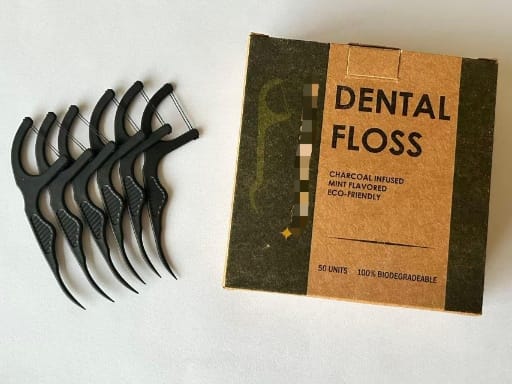
Richsource supplies multiple types of dental floss picks, including biodegradable, bamboo, eco-friendly, plastic-free, adult, kids, and orthodontic options, with material, specification, packaging, color, and branding customization available for B2B projects.
For buyers developing a new sustainable oral care line, this guide explains the material choices, performance questions, environmental claims, packaging considerations, and OEM decisions that should be evaluated before placing an order.
What Are Biodegradable Floss Picks?
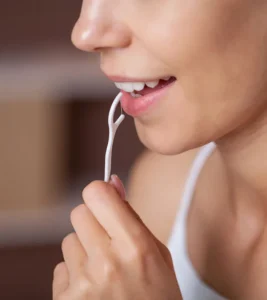
A floss pick combines a short section of dental floss with a molded or formed handle. The handle allows the user to guide the floss between teeth without wrapping a long strand of floss around the fingers.
Conventional floss pick handles are commonly designed around durable plastic materials because they can be molded efficiently and provide predictable mechanical strength. Biodegradable floss picks attempt to reduce reliance on conventional persistent plastics by using alternative materials or material systems designed for different end-of-life behavior.
The important distinction is that “biodegradable” describes an end-of-life characteristic rather than automatically identifying what the product is made from.
A bio-based material is made wholly or partly from biological feedstocks, while biodegradability describes whether a material can break down through biological processes under defined environmental conditions. A material can therefore be bio-based without necessarily being biodegradable.
The European Commission framework for bio-based, biodegradable and compostable plastics specifically distinguishes these concepts and notes that bio-based plastics can be either biodegradable or non-biodegradable.
That distinction matters for oral care brands because terms such as bio-based, biodegradable, compostable, recycled, bamboo-based, and plastic-free should not be treated as interchangeable.
Why Material Selection Matters for Floss Picks
For many products, material selection is mostly a question of appearance, cost, or durability. For floss picks, the material directly affects how the product performs.
The handle needs enough stiffness for the user to guide the floss through tight interdental spaces. If the material is too flexible, the product can feel unstable. If it is excessively rigid or poorly finished, the handle may feel uncomfortable.
The floss itself must also remain under appropriate tension. A handle that deforms during storage or use may change that tension and affect the cleaning experience.
This means a sustainable floss pick should be engineered as a complete system rather than treated as a conventional product made from a different resin.
For brands sourcing custom oral care products, material decisions should therefore be evaluated together with product geometry, floss type, packaging, expected shelf life, manufacturing process, target price, and market positioning.
Common Material Options for Sustainable Floss Picks
There is no single material that is automatically the best choice for every biodegradable floss pick project. Different materials have different processing characteristics, structural properties, appearances, environmental claims, and cost implications.
PLA-Based Materials
PLA, or polylactic acid, is one of the best-known materials used in bio-based product development. It can be produced from renewable feedstocks and may offer suitable molding characteristics for selected oral care applications.
For floss picks, PLA-based material systems can provide a relatively familiar molded appearance, making them suitable for brands that want an alternative to conventional plastic without radically changing the visual design of the product.
However, buyers should avoid assuming that every PLA product will quickly biodegrade in any natural environment. Disposal conditions matter, and claims should correspond to the actual formulation, testing method, certification, and intended waste-management environment.
Richsource identifies PLA among the biodegradable material options available through its oral care OEM and ODM manufacturing capabilities.
Bamboo-Based Material Concepts
Bamboo has strong consumer recognition and can communicate a natural product identity very quickly. Depending on the product design, bamboo may be used as a structural material or as part of a composite material system.
From a branding perspective, bamboo-based floss picks are particularly suitable for product ranges that already use kraft-style packaging, natural colors, minimalist design, or sustainability-focused positioning.
However, a buyer should still ask exactly how the handle is manufactured.
A product described as “bamboo” may not necessarily be a solid piece of bamboo. Some products may use bamboo fiber in a composite structure with a binding polymer. These configurations can have very different properties and end-of-life characteristics.
The percentage and type of each material therefore matter more than the marketing name alone.
Bio-Based Polymer Blends
Some floss pick projects use engineered blends rather than a single polymer.
This can help manufacturers tune specific properties such as:
- rigidity;
- toughness;
- moldability;
- surface finish;
- dimensional stability;
- heat resistance;
- production consistency.
A blended material can sometimes provide better manufacturing performance than a single resin, but buyers should understand that the presence of a plant-derived component does not by itself establish that the entire finished product is biodegradable.
When evaluating a blend, request information about the complete material composition rather than only the headline ingredient.
Reduced-Plastic and Alternative-Material Designs
Not every sustainability project needs to begin with an absolute “zero plastic” requirement.
Depending on the target market, some brands may achieve a more commercially practical product by reducing conventional plastic use, optimizing material quantity, simplifying packaging, or choosing alternative feedstocks while maintaining necessary product performance.
This can be especially relevant when the project has strict requirements for cost, shelf stability, automated production, or structural strength.
The right solution depends on what the brand actually wants to achieve: reduced fossil-based material, lower total material consumption, biodegradable components, compostability under defined conditions, a natural visual identity, or another measurable objective.
Biodegradable vs Compostable vs Bio-Based Floss Picks
These terms are frequently used together, but they should not be treated as synonyms.
| Term | What It Mainly Describes | Important Buyer Question |
|---|---|---|
| Bio-based | Where some or all raw material comes from | What percentage of the product is bio-based? |
| Biodegradable | Ability to biologically break down under specified conditions | Under what environment and timeframe? |
| Compostable | Biodegradation under defined composting conditions | Industrial or home composting? |
| Recyclable | Potential compatibility with a recycling stream | Is a suitable collection system actually available? |
| Plastic-free | Absence of materials considered plastic under the relevant definition | Does this apply to the handle, floss, packaging, or entire product? |
| Reduced-plastic | Lower use of conventional plastic compared with another design | What is the measurable reduction? |
The European Commission explains that compostable plastics are a subset of biodegradable plastics designed to biodegrade under controlled conditions, typically involving industrial composting.
For B2B buyers, this terminology should be clarified before package artwork is finalized. A product may have a sustainability advantage without qualifying for every possible environmental claim.
Do Not Treat “Biodegradable” as a Packaging Buzzword
One of the biggest risks in developing environmentally positioned oral care products is making claims that are broader than the available evidence.
In the United States, the FTC Green Guides provide guidance on environmental marketing claims. The guidance states that claims about degradability should be supported appropriately and warns against unqualified degradable claims when customary disposal conditions do not allow the complete product to break down within the relevant period.
For private-label buyers, the practical lesson is straightforward: product development and marketing development should happen together.
Before printing “biodegradable,” “compostable,” “eco-friendly,” “plant-based,” or similar language on packaging, clarify:
What part of the product does the claim apply to?
Which material is being referenced?
Under what conditions does degradation occur?
Is there a relevant test report?
Is the claim appropriate in the intended sales market?
Does the packaging wording accurately reflect the evidence?
Does disposal guidance need to be included?
This approach creates better product communication and reduces the risk of building a sustainability strategy around vague terminology.
The Handle Is Only Part of the Floss Pick
A common sourcing mistake is to evaluate only the handle material.
A complete floss pick may include several different material elements:
the handle, dental floss filament, wax or coating, flavoring where applicable, additives, colorants, individual wrapper, inner packaging, and outer retail package.
Changing the handle does not automatically change the environmental profile of every other component.
For example, a biodegradable handle paired with a conventional floss filament may still be a meaningful product-development step, but the environmental claim should accurately describe the component to which it applies.
This is why experienced buyers evaluate the entire bill of materials rather than relying only on the visible handle.
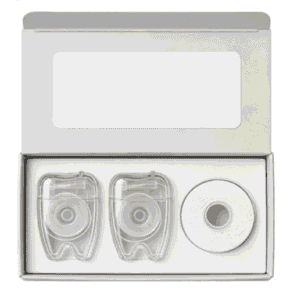
Richsource also produces dental floss rolls, allowing projects to consider both handle and floss specifications when developing private-label interdental cleaning products.
Performance Requirements Buyers Should Test
Sustainability does not eliminate the normal performance requirements of an oral care product.
For biodegradable floss picks, sample evaluation should include several practical factors.
Handle Rigidity
The handle should remain sufficiently stable when pressure is applied during use. Excessive flex can make it difficult to control the floss, especially around posterior teeth.
Floss Tension
The floss needs to remain properly tensioned between the arms of the pick. Material deformation or dimensional variation can reduce consistency.
Floss Retention
The floss should remain securely attached during normal use. Buyers should evaluate the attachment structure together with the selected handle material.
Edge and Surface Quality
Molded surfaces should feel smooth and controlled. Flash, sharp edges, rough transitions, or inconsistent finishing can negatively affect the consumer experience.
Storage Stability
Product performance should remain consistent during its intended shelf period. Heat, moisture, packaging environment, and transportation conditions should all be considered when selecting a material.
Packaging Compatibility
Some alternative materials may respond differently to temperature, humidity, or long-term storage than conventional plastics. Packaging selection therefore needs to be tested together with the final product rather than treated as a separate purchasing decision.
How to Compare Biodegradable Floss Pick Materials
A buyer comparing samples should use a structured evaluation rather than choosing the sample that simply “looks the most natural.”
A useful sourcing matrix might look like this:
| Evaluation Area | What to Check | Why It Matters |
| Material composition | Resin, fiber, fillers and additives | Determines realistic product claims |
| Handle stiffness | Flex during normal pressure | Affects user control |
| Dimensional stability | Shape before and after storage | Influences floss tension |
| Surface quality | Smoothness and molding consistency | Affects comfort and perceived quality |
| Floss specification | Material, thickness, coating, flavor | Influences cleaning experience |
| Environmental claim | Test method and applicable conditions | Supports accurate marketing |
| Packaging | Individual wrap, pouch, box or bulk format | Influences hygiene and retail positioning |
| Customization | Color, shape, logo and specifications | Builds brand differentiation |
| MOQ | Minimum viable production quantity | Affects launch strategy |
| Production scalability | Repeatability at larger volumes | Important for long-term supply |
| Quality control | Incoming, process and final inspection | Reduces batch variation |
This framework is particularly useful when comparing quotations from different manufacturers because two floss picks that appear similar in a photograph may have very different material compositions and manufacturing specifications.
Packaging Can Strengthen or Undermine the Product Positioning
Sustainable oral care development should not stop at the floss pick itself.
A biodegradable floss pick packed in unnecessarily complex multi-layer packaging may create a confusing brand message. At the same time, eliminating necessary protective packaging simply to reduce material may compromise hygiene, storage, shipping efficiency, or shelf presentation.
The better approach is packaging optimization.
Depending on the market, a brand may consider:
- compact cartons;
- recyclable paper-based outer packaging;
- reduced packaging dimensions;
- bulk packs;
- individual wrapping for hospitality or hygiene-sensitive channels;
- minimalist printing;
- clearly separated disposal instructions;
- material-specific environmental information.
Packaging should correspond to where the product will actually be sold.
A pharmacy product, e-commerce refill pack, hotel amenity, dental clinic sample, supermarket retail box, and travel product may all need different packaging structures even if the floss pick inside is similar.
Biodegradable Floss Picks for Different Sales Channels
Material choice should also reflect the intended buyer and retail environment.
Retail and Supermarket Brands
Retail products need strong shelf communication. Sustainability information must be easy to understand without overwhelming the front of the package.
Consumers may respond to visible material cues, natural colors, simplified packaging, and clearly explained environmental attributes.
Dental and Oral Care Brands
Specialist oral care brands usually need a stronger balance between environmental positioning and functional credibility.
Floss tension, handle control, smoothness, and cleaning performance should remain central to the product message.
The American Dental Association’s manual interdental cleaner requirements cover product categories including dental floss, dental picks, and interdental brushes, illustrating why interdental cleaning products should be approached as functional oral care tools rather than merely lifestyle accessories.
Hotels and Hospitality
Hospitality customers may prioritize individual packaging, hygiene, compact formats, and easy distribution.
For this market, packaging customization can be just as important as handle material.
Subscription and E-Commerce Brands
Online-first brands often have more space to explain material details, disposal conditions, product design, and manufacturing choices.
This makes them particularly suitable for products where sustainability requires more explanation than a short retail package can provide.
Private-Label Oral Care Programs
Private-label buyers may need an entire product family rather than one SKU.
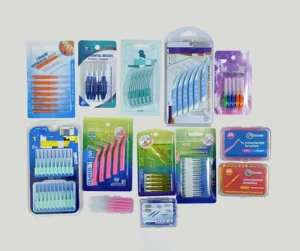
A biodegradable floss pick can be positioned alongside conventional floss, interdental brushes, tongue cleaners, or other oral care product lines to create a broader branded oral hygiene range.
OEM Customization Options for Biodegradable Floss Picks
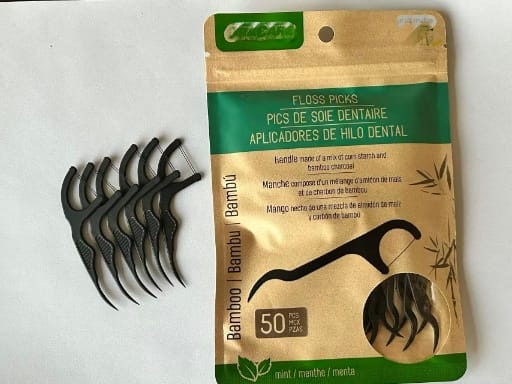
For B2B buyers, one of the biggest advantages of working directly with an oral care manufacturer is the ability to build a product around the target market rather than simply selecting an existing generic item.
Typical customization areas include:
Material
The handle material can be selected according to sustainability goals, structural requirements, target cost, and market positioning.
Handle Design
Shape influences comfort, grip, accessibility, visual identity, and material consumption. Existing designs may allow faster development, while a custom mold can create stronger differentiation for larger programs.
Floss Specification
Depending on the project, brands can evaluate floss thickness, texture, coating, flavor, color, and other performance characteristics.
Color
Natural tones may reinforce sustainability positioning, while custom brand colors can create stronger shelf recognition.
Packaging
Individual wrappers, pouches, boxes, multi-count retail packs, travel packs, and other packaging formats can be developed around the target channel.
Branding
Logo, private-label graphics, instructions, barcodes, market-specific text, and other package information can be incorporated into the final program.
Richsource provides OEM/ODM support from product design and material selection through packaging customization and mass production. Buyers developing a biodegradable floss pick range can contact Richsource for project evaluation and quotation.
Questions to Ask a Biodegradable Floss Pick Manufacturer
Price should never be the only question in a sourcing discussion.
A more useful RFQ includes questions such as:
- What exactly is the handle material?
- What percentage of the formulation is bio-based, if applicable?
- Under which conditions is the material described as biodegradable?
- What supporting documentation is available?
- Does the claim apply to the handle or the complete floss pick?
- What floss materials and specifications are available?
- Can handle stiffness or product dimensions be adjusted?
- What packaging options are suitable for the selected material?
- Can individual wrapping be provided?
- What private-label services are available?
- Is custom color available?
- Can a custom mold be developed?
- What sample options are available before mass production?
- What quality inspections are performed?
- What is the MOQ for an existing design versus a customized design?
- What lead time should be expected after artwork and sample approval?
- What export or market documentation can be supplied?
These questions help turn a general quotation into a meaningful comparison between manufacturers.
A Better Way to Build a Sustainable Floss Pick Product
The strongest sustainable product strategy usually begins with a precise requirement rather than an environmental buzzword.
For example, instead of telling a supplier:
“We need an eco-friendly floss pick.”
A stronger project brief might say:
“We need a private-label floss pick for a natural oral care brand. The priority is reducing conventional fossil-based plastic while maintaining sufficient handle rigidity. We need clear documentation for all environmental claims, paper-based retail packaging where technically suitable, custom artwork, and a product format that can scale to large retail orders.”
The second brief gives the manufacturer enough information to evaluate materials, tooling, packaging, production, and cost as one system.
It also creates a more defensible product story for the brand.
Frequently Asked Questions
Are biodegradable floss picks completely plastic-free?
Not necessarily. “Biodegradable” and “plastic-free” describe different characteristics. A biodegradable floss pick may use a biodegradable polymer, while some components such as floss or packaging may use other materials. Buyers should verify the complete material specification before making a plastic-free claim.
Is PLA biodegradable?
PLA can biodegrade under appropriate conditions, but brands should not assume that a PLA product will rapidly break down under every disposal condition. The formulation, product geometry, temperature, moisture, microorganisms, and waste-processing environment can all influence degradation. Environmental claims should be based on appropriate evidence and the intended market.
Are bio-based and biodegradable the same thing?
No. Bio-based refers to the source of the feedstock, while biodegradable describes end-of-life breakdown under specified conditions. The European Commission specifically notes that bio-based plastics may be biodegradable or non-biodegradable.
Are biodegradable floss picks compostable?
Some material systems may be designed for composting under defined conditions, but biodegradable and compostable are not automatically equivalent. Buyers should confirm whether a claim relates to industrial composting, home composting, or another environment and review supporting documentation before using the claim commercially.
Can biodegradable floss picks be individually wrapped?
Yes, individual packaging can be developed for relevant applications such as hospitality, travel, sampling, retail, or hygiene-sensitive distribution. However, the wrapper material should be selected as part of the complete sustainability and packaging strategy.
Can a brand customize biodegradable floss picks?
Yes. Depending on the design and project requirements, customization can include handle material, shape, color, floss specification, packaging, logo, and private-label artwork. Richsource provides OEM/ODM oral care manufacturing solutions for brands, distributors, retailers, and other B2B buyers.
What should buyers test before bulk ordering?
Important checks include handle stiffness, floss tension, floss retention, surface finish, dimensional consistency, packaging compatibility, storage stability, material documentation, labeling requirements, and production sample consistency.
What information should I send when requesting a quotation?
Provide the target market, expected order quantity, preferred material, product style, floss specification, packaging format, logo requirements, color, sustainability requirements, certification or documentation needs, and expected delivery schedule. The more detailed the brief, the easier it is for a manufacturer to propose a commercially appropriate solution.
Conclusion
Biodegradable floss picks are not simply conventional floss picks made in a different color or marketed with an environmental label. Developing a competitive product requires careful coordination between material composition, structural performance, floss specifications, packaging, environmental claims, manufacturing consistency, cost, and the expectations of the target market.
For buyers, the most important step is to define what sustainability means for the specific project. A brand seeking reduced conventional plastic use may need a different material solution from one seeking industrial compostability, a bamboo-based appearance, a plant-derived feedstock, or a plastic-free product concept.
Environmental terminology should also remain precise. Bio-based, biodegradable, compostable, recyclable, and plastic-free describe different attributes, and responsible brands should make claims that accurately reflect the final product and available evidence.
For companies developing private-label or wholesale sustainable oral care ranges, Richsource offers biodegradable and eco-friendly dental floss pick options together with material selection, product customization, packaging development, branding, OEM/ODM manufacturing, and bulk production support.
If you are planning a new biodegradable floss pick, eco-friendly interdental cleaning range, or private-label oral care project, contact Richsource to discuss your specifications and request a quotation.
Stay Connected! 🌟
Thanks for reading! If you enjoyed this article, don’t forget you can follow me on social media for more insights, updates, and behind-the-scenes content:
Facebook – Join the conversation and get the latest updates
YouTube – Watch tutorials, demos, and in-depth guides
Instagram – See tips, visuals, and daily inspiration
Let’s continue learning and growing together—stay connected and never miss a beat!